What should you do next?
Commission one pilot suit only after you have a workable fitting calendar, an exact specification, a complete cost comparison and a named party…
Commission planningRead research ↗

Research / 12
Turn what you have learned into a commission brief, a fitting plan and a clear before-deposit checklist.
Commission one pilot suit only after you have a workable fitting calendar, an exact specification, a complete cost comparison and a named party…
Write a one-page brief before contacting suppliers. Ask candidates to quote against the same requirements rather than comparing differently specified…
Shortlist on documented process, then test suitability. Do not treat the words “bespoke,” “handmade” or “full canvas” as interchangeable evidence.
Build the calendar around garment stages, not the promise “ready before your flight.” Filo’s published schedule is one house’s advertised approach, not a…
Approve a garment specification, not a collection of adjectives. Treat cloth identity, construction and fit process as separate commitments.
Compare the cost of achieving an acceptable suit, not the garment price alone. The FTC’s shopping guidance explicitly includes taxes, shipping, handling…
Put responsibility for an unsuccessful result in writing. Ask for more than “free alterations” or “satisfaction guaranteed.”
Describe what you see and feel; ask the cutter to diagnose the cause. For example, Proper Cloth’s technical guidance notes that collar rolls can involve…
Use a specialist to resolve a decision that could change the purchase—not merely to produce a more polished shortlist. No source reviewed establishes an…
This is an action window, not a tailoring lead-time claim .
Sources below support the factual statements; the decision protocol is this desk’s editorial recommendation. Research included official guidance, supplier…
No matching research. Try another term or choose All.
Executive Bespoke Suits ResearchResearch checked: October 19, 2026
Commission one pilot suit only after you have a workable fitting calendar, an exact specification, a complete cost comparison and a named party responsible for corrections. If any of those remains unresolved, clarify the agreement before paying—not after the cloth has been cut.
This document provides a buyer-side decision protocol, not a supplier ranking. Its checklists are recommendations; cited supplier descriptions remain supplier statements, not independently verified workmanship or delivery outcomes.
For this desk, bespoke means individual pattern development and a fitting-led process permitting substantive adjustment to posture, balance and silhouette. The Savile Row Bespoke Association provides a useful reference point: its process specifies an individually handmade pattern cut by a master cutter. That is a benchmark, not certification of any Vietnamese business. (savilerowbespoke.com)
| Your position | Next action | Proceed only when… |
|---|---|---|
| You have an immovable event deadline | Compare an accessible US option before committing overseas | The proposed fitting and correction schedule fits the deadline |
| You already have a Vietnam itinerary | Send your actual appointment windows to candidate tailors | The cutter confirms intermediate fittings and a final assessment opportunity |
| You want a first suit entirely remotely | Request the trial-garment, feedback and remake process | You understand how fit will be assessed and who funds unsuccessful corrections |
| You have persistent posture or shoulder problems | Obtain a technical assessment before choosing the commissioning route | A competent cutter explains the proposed adjustments and fitting access |
| You are considering several suits | Separate the pilot from subsequent cutting authorization | You can approve the first suit before releasing the rest |
| You have already paid a deposit | Assemble the order, payment record and correspondence; request written clarification | Outstanding stages and remedies are documented without assuming new terms apply retrospectively |
Our recommended specialist intervention point is before the first irreversible commitment: a nonrefundable deposit, cloth cutting, extra travel booking or authorization to make several garments. The specialist section below explains when that expense is proportionate—and when it is not.
Write a one-page brief before contacting suppliers. Ask candidates to quote against the same requirements rather than comparing differently specified “bespoke packages.” The FTC similarly recommends recording the complete price, delivery expectations and refund arrangements when assessing an unfamiliar online seller. (consumer.ftc.gov)
For a conservative executive wardrobe, make the brief about the desired business appearance and comfort rather than an exhaustive list of decorative details. Ask the cutter to explain any conflict between your references, the house style and your fit requirements.
Assistant’s role: collect quotations, maintain the appointment calendar and record decisions. Reserve the wearer’s time for fit, comfort and style approval; do not delegate those judgments entirely.
Output: one brief that every shortlisted supplier receives unchanged.
Shortlist on documented process, then test suitability. Do not treat the words “bespoke,” “handmade” or “full canvas” as interchangeable evidence.
Ask separately about:
The separation matters: the Savile Row association describes individual pattern cutting and canvas work as distinct elements of its process, while Suitsupply offers a choice of canvas construction within its Custom Made service. Construction terminology alone therefore does not answer the individual-pattern question. (savilerowbespoke.com)
These are examples of questions to investigate, not recommendations or a ranked shortlist.
| Supplier evidence found | What you can reasonably take from it | What still needs confirmation |
|---|---|---|
| Binh Tailor describes individual paper patterns and a structural basting stage | There is a published process against which to request a quotation | Whether that process applies to your price tier, dates and assigned cutter. (binhtailor.com.vn) |
| TIE MEN describes individual paper patterns and successive fittings | Pattern development and fitting are explicit supplier claims | Who will conduct your fittings and what records will be retained. (tiemen.vn) |
| Filo publishes a traveler schedule with consultation on days 1–2, fitting on days 7–9 and delivery on days 10–12 | There are concrete scheduling assumptions to test | Current availability, adjustment time and the remedy if the final suit ships after departure. (filobespoke.com) |
Recheck operational details immediately before booking. For example, TIE MEN announced that its partnership at its former Da Nang location ended on October 15, 2026; a replacement showroom was anticipated for November, with its address and opening date not yet confirmed on the page checked. An older directory is not appointment confirmation. (tiemen.vn)
Label each finding supplier-stated, independently checked, buyer-provided or unresolved. An unanswered question is a gap—not proof of misconduct.
Output: a small candidate set with comparable evidence. Do not fill an arbitrary three-supplier shortlist if only one or two meet your requirements.
Build the calendar around garment stages, not the promise “ready before your flight.” Filo’s published schedule is one house’s advertised approach, not a universal minimum for Vietnam. Conversely, Huntsman states that timing depends on fitting availability and distinguishes new-client fittings from repeat orders using an established pattern. (filobespoke.com)
| Stage | Confirmation required | Your decision |
|---|---|---|
| Consultation | Date, location, named fitter and cutter availability | Does the proposed style and process suit you? |
| Cloth approval | Exact reference, availability and cutting authorization | Is the specification complete? |
| Intermediate fitting | Date, garment stage and changes still possible | Can the cutter address the problems observed? |
| Correction and recheck | Workshop time and another appointment if needed | Are the changes successful? |
| Final assessment | Appointment before collection or an agreed remote acceptance route | Is the finished suit ready for its intended use? |
| Aftercare | Contact, response window, remedy and cost allocation | Can a problem be resolved after you return home? |
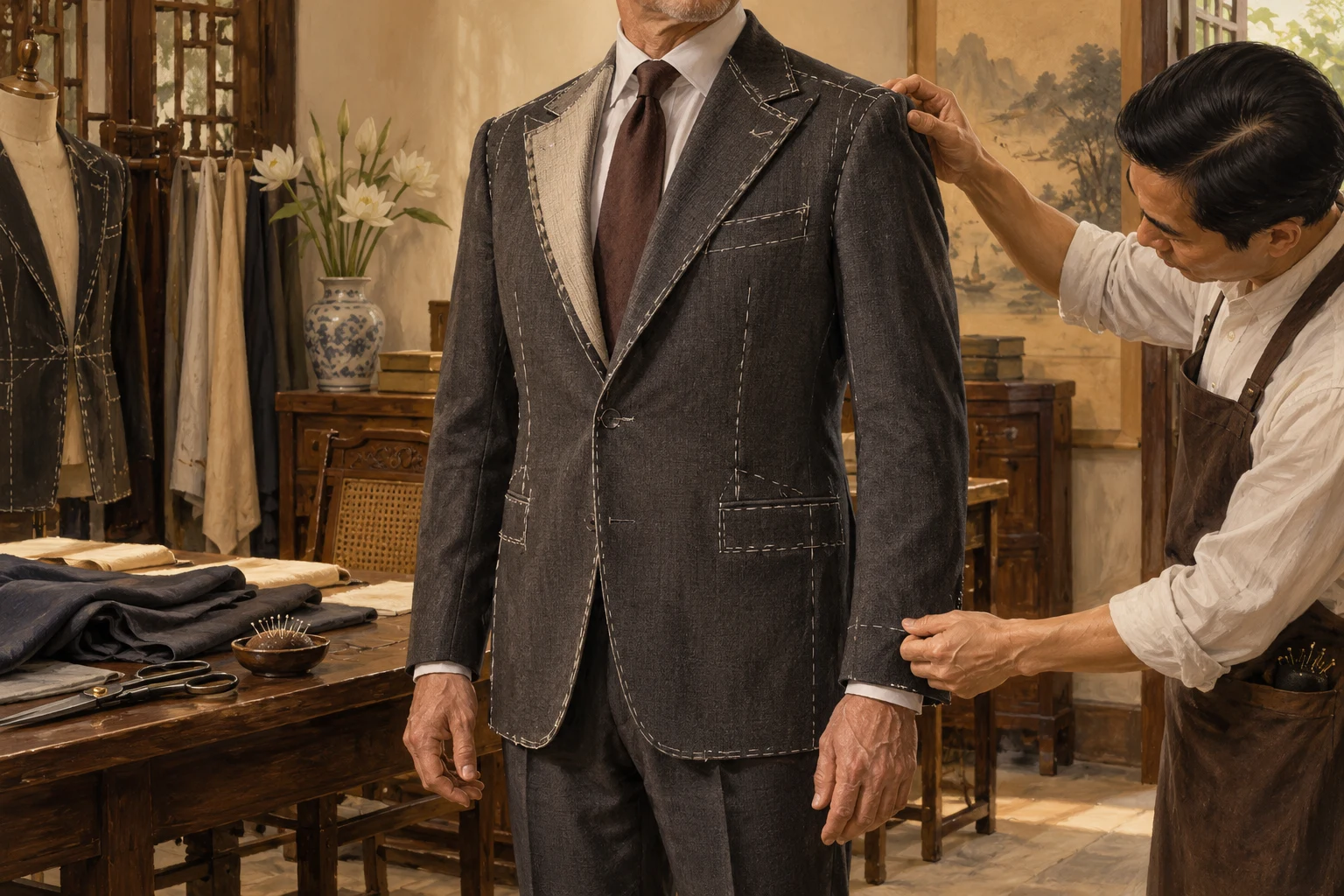
A basted fitting uses temporary assembly so the tailor can assess and revise the garment before permanent finishing. De Oost’s published demonstration identifies balance, shoulder line, sleeve rotation and shaping among the areas reviewed; the presence of white stitches alone should not be your acceptance test. (deoost.com)
Stop condition: if the plan works only when no correction is needed, do not treat it as a sufficiently tested first-commission plan.
Ask the US contact directly whether they provide measurements, an unfinished-garment fitting, finished-garment alterations or merely collection. Require the workshop and US provider to acknowledge the same scope and remedy arrangement.
As a comparison benchmark—not a Vietnam-production recommendation—Huntsman’s New York page names a cutter responsible from measurement through final fitting and describes a baste stage. That is the kind of operational specificity to request from a claimed US partner. (huntsmansavilerow.com)
This review did not independently verify a Vietnamese workshop–US fitting partnership with documented intermediate fittings and joint correction accountability. Do not infer one from worldwide shipping or an overseas address.
Approve a garment specification, not a collection of adjectives. Treat cloth identity, construction and fit process as separate commitments.
For named cloth, request supporting material from the actual producer or merchant. Vitale Barberis Canonico states that its technical sheets contain composition and care information; it also offers production-batch QR codes through its transparency passport program. Ask whether the proposed cloth has applicable documentation rather than assuming every length comes with a passport. (vitalebarberiscanonico.shop)
Evidence boundary: treat a label photograph, swatch or QR code as one supporting item. Do not promote it to independent authentication of the cloth in your finished suit without a traceable connection to the order.
If provenance materially affects the price, ask a specialist to seek confirmation from the merchant or mill before cutting. Agree the scope of that check: documentary verification is not the same as laboratory fiber testing or workshop inspection.
Output: a signed or expressly accepted specification with no unapproved substitutions.
Compare the cost of achieving an acceptable suit, not the garment price alone. The FTC’s shopping guidance explicitly includes taxes, shipping, handling and return-shipping responsibility in the purchase comparison. (consumer.ftc.gov)
Use this desk’s worksheet:
Delivered cash cost = garment + separate fitting fees + shipping + applicable import charges + payment/FX costs + local alterations + incremental travel + advisory fees.
Record other applicable taxes separately where relevant. Do not assign a zero to a charge merely because the quotation omits it.
| Cost category | Evidence to obtain |
|---|---|
| Garment and upgrades | Itemized quotation tied to the specification |
| Fitting and aftercare | Included stages, exclusions and separately payable services |
| Delivery | Carrier, service, insurance and who pays each charge |
| Import treatment | Dated route-specific estimate and assumptions |
| Payment and currency | Settlement currency, conversion method and provider fees |
| Corrections | Written allowance or separately quoted scenario—not an assumed average |
| Travel | Only expenditure caused by the commission |
| Specialist review | Fixed scope, fee and exclusions |
Do not assume a suit shipped for less than $800 enters duty-free. CBP’s June 24, 2026 rules provide for indefinite suspension of the low-value de minimis exemption for postal and non-postal merchandise. This does not establish a single duty rate for every suit. (govinfo.gov)
Accompanied baggage is a separate question. CBP’s traveler guidance describes an $800 personal exemption in most cases, subject to conditions including personal use, accompanying the traveler, declaration, generally at least 48 hours abroad and restrictions on recent use of the exemption. Goods sent later generally cannot be included in that allowance. (help.cbp.gov)
For a shipment estimate, provide the carrier or broker with the garment description, composition, origin, value and intended entry route. Ask them to identify the classification and all charges assumed. Use current official material: the USITC tariff-information page checked for this report announced 2026 HTS Revision 21 on October 9, 2026. (usitc.gov)
This report does not quote a universal Vietnam-to-US suit duty rate. Reconfirm treatment close to shipment or return travel; a postal-process proposal is not automatically an effective requirement.
Calculate:
Remaining cost advantage = comparable US delivered cost − Vietnam delivered cost.
Then show three separately labeled scenarios:
Do not assign probabilities without evidence. Keep executive hours separate, with optional valuation using the buyer’s own assumption.
Decision rule: if plausible additional costs exceed the remaining advantage, choose Vietnam only for a clearly stated non-price reason—not because the headline quotation still looks inexpensive.
Put responsibility for an unsuccessful result in writing. Ask for more than “free alterations” or “satisfaction guaranteed.”
| Problem | Ask the agreement to identify… |
|---|---|
| Fit is unacceptable | Who assesses it and authorizes the remedy |
| US alteration is proposed | Who approves the work, pays and updates the pattern |
| A remake is needed | Scope, timing, cloth availability and shipping responsibility |
| Replacement cloth is unavailable | Buyer approval and alternative remedy |
| The deadline is missed | Communication, revised timing and cancellation/remedy provisions |
| Workshop and local fitter disagree | A named escalation owner and decision process |
Use published policies as comparison material, not promises that transfer between businesses. Proper Cloth currently lists local-tailor store credit up to $125 for a suit, a company alteration/remake route, or a refund; its page also excludes returns of altered clothing. The important lesson is to compare the form of reimbursement and exclusions, not just the word “guarantee.” (propercloth.com)
No. The FTC recommends paying by credit card for online purchases, but payment protection should supplement—not replace—the agreement. (consumer.ftc.gov)
Ask your issuer about the transaction before paying. CFPB guidance identifies a 60-calendar-day written-notice deadline for billing errors after the charge appears on the statement, while warning that defective-goods disputes may follow a different process. Do not treat that as a universal 60-day fit guarantee or assume overseas custom-garment disputes are automatically covered. (consumerfinance.gov)
Output: a complete order pack saved with the quotation, correspondence and payment receipt.
Describe what you see and feel; ask the cutter to diagnose the cause. For example, Proper Cloth’s technical guidance notes that collar rolls can involve posture or shoulder slope. A visible symptom does not necessarily identify one simple alteration. (propercloth.com)
These are prompts for the fitting discussion, not a remote diagnostic test. The technical purpose of an intermediate fitting is illustrated by the adjustments documented in De Oost’s baste-fitting demonstration. (deoost.com)
If the supplier proposes that a local tailor “fix it when you get home,” ask for the proposed work, authorization, payer and fallback remedy first.
Our recommendation is to release repeats only after the pilot is approved, any permitted real-use assessment is complete, and corrections have been incorporated into the retained specification or pattern. Confirm return and wear conditions before conducting that assessment.
Huntsman’s FAQ says established patterns may permit fewer fittings on later orders. That supports the value of a successful starting pattern—not skipping validation on a first commission. (huntsmansavilerow.com)
Repeat-order checklist: approved fit; updated pattern record; confirmed cloth; unchanged or rechecked body measurements; documented style changes; agreed delivery and remedies. Do not assume a different cloth or silhouette can be copied without review.
Use a specialist to resolve a decision that could change the purchase—not merely to produce a more polished shortlist. No source reviewed establishes an average saving from buyer-paid Vietnamese-tailoring verification, so a claim that the service “pays for itself” would be unsupported.
| Trigger | Suitable specialist | Commission this deliverable | Best intervention point |
|---|---|---|---|
| Persistent shoulder, posture or balance problems | Experienced bespoke cutter or technical fitter | Fit assessment and route recommendation | Before deposit |
| Conflicting bespoke, construction or cloth claims | Independent tailoring adviser with relevant technical experience | Evidence review and prioritized supplier questions | Before cutting |
| Claimed US support with divided responsibilities | Buyer-side adviser, with both providers participating | Written responsibility and remedy map | Before either provider is paid |
| Uncertain shipment charges | Carrier customs team or licensed customs broker | Dated classification and charge estimate | Before commitment; refresh before dispatch |
| Proposed wardrobe order | Technical fitter plus purchasing coordinator where needed | Pilot approval and repeat-release record | Before additional cutting |
| Unresolved delivery or quality dispute | Technical assessor; issuer or legal adviser as appropriate | Documented problem, remedy request and deadline review | Promptly after the problem emerges |
Before hiring, require answers to five questions:
Compare the fee with the remaining cost advantage, expenditure still avoidable and the coordination time you personally value. This is a decision test, not a promised return.
Do not buy specialist research when the answer is already clear. If the itinerary cannot accommodate the required fittings, choose another route. If an accessible US option meets the brief and deadline at an acceptable total price, purchasing it is a valid outcome.
This is an action window, not a tailoring lead-time claim.
I am considering one pilot business suit before any repeat order. Please confirm the contracting business, total price, exact cloth and construction, who measures/cuts/makes/corrects, and whether the quoted service includes an individual pattern and intermediate fittings. Please map the appointments to my dates and explain what happens if further fitting is needed after departure. Please also specify alteration, remake and refund terms; who pays US assessment and return-delivery costs; and whether any third-party alteration requires your approval. No additional garments should be cut without my separate written authorization.
The next step is not necessarily a deposit. It is a documented decision about how you will obtain—and, if necessary, correct—one acceptable suit.
Sources below support the factual statements; the decision protocol is this desk’s editorial recommendation. Research included official guidance, supplier documentation, specialist media, recruiting pages and video/podcast material. No workshop inspection, test commission, customer-outcome audit or issuer-specific legal assessment was performed.
https://www.savilerowbespoke.com/about-us/bespoke-process/https://www.binhtailor.com.vn/bespoke-tailoringhttps://tiemen.vn/https://www.filobespoke.com/blog/post/getting-a-custom-suit-made-in-vietnam-what-every-traveler-needs-to-knowhttps://suitsupply.com/en-us/journal/custom-made.htmlhttps://www.huntsmansavilerow.com/pages/huntsman-on-w57thhttps://www.huntsmansavilerow.com/pages/how-may-we-help-you-faqshttps://www.deoost.com/blog/the-difference-between-fitting-methodshttps://vitalebarberiscanonico.com/news-and-events/transparency-digital-passport/https://vitalebarberiscanonico.shop/me-en/faq/5-where-can-i-find-technical-and-fabric-treatment-information/https://consumer.ftc.gov/consumer-alerts/2021/06/shopping-online-know-your-retailer-your-rightshttps://www.govinfo.gov/content/pkg/FR-2026-06-24/pdf/2026-12669.pdfhttps://www.govinfo.gov/content/pkg/FR-2026-06-24/pdf/2026-12670.pdfhttps://www.help.cbp.gov/s/article/Article-1402?language=en_UShttps://www.usitc.gov/harmonized_tariff_informationhttps://www.consumerfinance.gov/ask-cfpb/how-do-i-dispute-a-charge-on-my-credit-card-bill-en-61/https://propercloth.com/perfect-fit-guaranteehttps://propercloth.com/reference/how-jacket-posture-should-fit/Obtain an exact specification, a fitting calendar, a complete cost comparison and written correction responsibilities. Our recommended purchase structure is one pilot suit, with separate authorization before any repeat garments are cut.
Ask how the individual pattern is developed and revised, which intermediate fittings are included and who conducts them. The Savile Row Bespoke Association specifies an individually handmade pattern cut by a master cutter; use that as a process benchmark, not as certification of the Vietnamese supplier. (savilerowbespoke.com)
Use the chosen supplier’s confirmed stage-by-stage calendar rather than a universal minimum. For example, Filo advertises consultation on days 1–2, fitting on days 7–9 and delivery on days 10–12, but availability and additional corrections still require confirmation for your order. (filobespoke.com)
Treat US support as meaningful only after the workshop and local provider agree on who assesses fit, authorizes changes and pays for unsuccessful corrections. Ask whether the US service includes unfinished-garment fittings or only measurements and alterations to the delivered suit.
Do not assume so: CBP’s June 24, 2026 rules provide for indefinite suspension of low-value de minimis treatment for postal and non-postal merchandise. Obtain a dated estimate for the actual garment and shipment route rather than treating the suspension as one universal suit duty rate. (govinfo.gov)
Yes: accompanied purchases are assessed under traveler rules, separately from ordinary shipped orders. CBP describes an $800 personal exemption in most cases subject to eligibility conditions, declaration and other restrictions; items sent later generally cannot use that allowance. (help.cbp.gov)
No; ask the issuer about coverage and deadlines for the specific transaction. CFPB distinguishes billing errors, for which it describes a 60-day written-notice deadline after the charge appears on the statement, from defective-goods disputes that may use a different process. (consumerfinance.gov)
Our recommendation is to seek technical help before deposit or cutting when difficult fit, contradictory specifications or divided US–Vietnam responsibilities could change the purchase decision. Require a fixed scope, a written deliverable and disclosure of supplier relationships; there is no verified average saving that justifies promising the fee will pay for itself.
Release additional cutting only after approving the pilot and confirming that its corrections are reflected in the retained pattern or specification. Huntsman’s FAQ notes that established patterns may allow fewer fittings on subsequent orders, but that does not validate an untested first commission. (huntsmansavilerow.com)
](https://www.savilerowbespoke.com/about-us/bespoke-process/)](https://www.binhtailor.com.vn/bespoke-tailoring)](https://tiemen.vn/)](https://www.filobespoke.com/blog/post/getting-a-custom-suit-made-in-vietnam-what-every-traveler-needs-to-know)](https://suitsupply.com/en-us/journal/custom-made.html)](https://www.huntsmansavilerow.com/pages/huntsman-on-w57th)](https://www.huntsmansavilerow.com/pages/how-may-we-help-you-faqs)](https://www.deoost.com/blog/the-difference-between-fitting-methods)](https://vitalebarberiscanonico.com/news-and-events/transparency-digital-passport/)](https://vitalebarberiscanonico.shop/me-en/faq/5-where-can-i-find-technical-and-fabric-treatment-information/)](https://consumer.ftc.gov/consumer-alerts/2021/06/shopping-online-know-your-retailer-your-rights)](https://www.govinfo.gov/content/pkg/FR-2026-06-24/pdf/2026-12669.pdf)](https://www.govinfo.gov/content/pkg/FR-2026-06-24/pdf/2026-12670.pdf)](https://www.help.cbp.gov/s/article/Article-1402?language=en_US)](https://www.usitc.gov/harmonized_tariff_information)](https://www.consumerfinance.gov/ask-cfpb/how-do-i-dispute-a-charge-on-my-credit-card-bill-en-61/)](https://propercloth.com/perfect-fit-guarantee)](https://propercloth.com/reference/how-jacket-posture-should-fit/)Source collection for this chapter · research dated 2026-10-19. Inline citations identify the source supporting each passage.